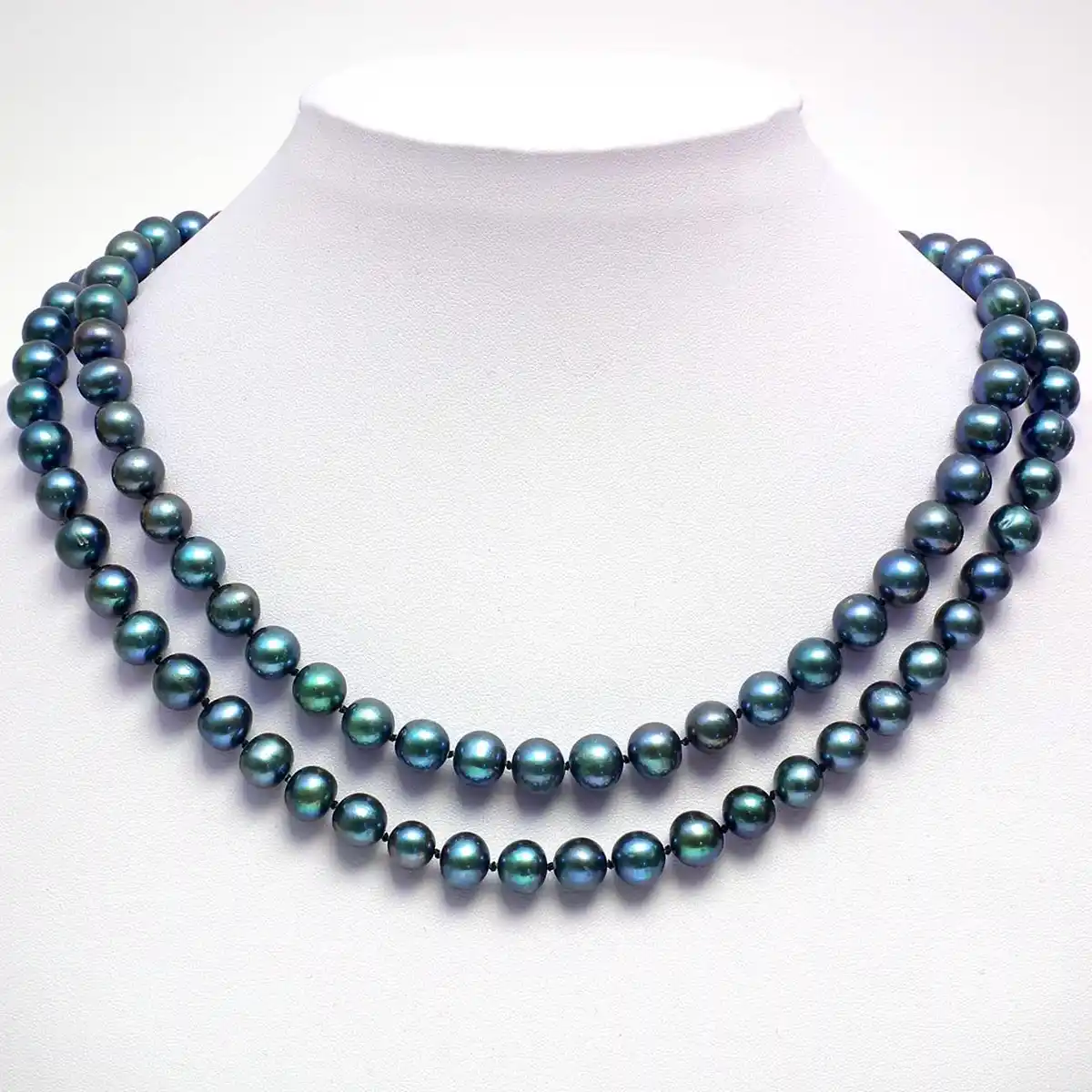
Stringing Pearls
Stringing since 1979!


Naturally occurring pearls are now so rare that they are priced out of the reach of all but the richest of collectors. Found in remaining numbers only off the coasts of Australia and some Middle Eastern Countries, natural pearls are found at the rate of only three or four per ton harvested, with perfect pearls being even rarer. Therefore, in order to learn about pearls, a key factor is that virtually all pearls used in jewellery these days are cultivated by inserting a tiny bead or shaped insert made from the polished shell into a specially bred oyster or mussel – in fact, a specially bred hybrid of the two creatures is most commonly used.
Irritated by the bead, the mollusc surrounds it with a coat of calcium carbonate to form nacre (a.k.a. mother of pearl). After anywhere between six months and seven years (depending on the species of mollusc and the product being made), the oyster will be removed from the water and opened to reveal a pearl.
The science of cultivating pearls was perfected by Japanese scientists in the 1930s who invested considerable time to learn about pearls. Using species of mollusc which could survive in a lake was found to be more convenient and cost-effective than growing pearls in the sea and so the term ‘Freshwater Pearls’ was born.
Most of the pearls offered for sale these days are freshwater pearls. Originally cultivated in Japan, most notably in the famous Lake Biwa, production has almost entirely been moved to China, especially in the area around Shanghai, since the Japanese industry fell victim to increased water pollution.
Some types of pearl, such as South Sea, Tahitian and Akoya, are still cultivated in saltwater lagoons but these are considerably more expensive.
When people learn about pearls, they often discover that “type” isn’t only about where the pearl grew — shape plays a huge role in the final style.
Round and Near-round – These are the shapes most people picture first. Round pearls often command a premium because they’re harder to match consistently in strands.
Drop and Oval – Elegant shapes commonly used in earrings and pendants, and also in necklaces for a softer, more organic look.
Button pearls – Flatter pearls that can be ideal for earrings and pieces where you want a pearl to sit close to the skin.
Baroque pearls – Baroque pearls are irregular and individual — each one has its own character. They’re popular for statement jewellery and creative modern designs. (Learn more: What is it about Baroque Pearls?)
Coin pearls – Coin pearls are flatter “disc-like” pearls that can add a contemporary look, especially in necklaces.
The desirable lustre and iridescence of a pearl are caused by light refracting off the different layers of nacre that have been built up. Pearls can occur naturally in many different colours although many are dyed for uniformity. Being an organic substance, pearls absorb dyes well and so the colour will not rub off and should not fade, although certain colours may lighten if exposed to strong sunlight for long periods.
| Factor | Description | Impact on Value |
|---|---|---|
| Size | Measured in mm (e.g., 5-16mm) | Larger sizes are rarer and pricier. |
| Luster | Sharpness of light reflection | High luster increases desirability. |
| Surface Quality | Blemishes like pits or cracks | Cleaner surfaces command premium. |
| Shape | Round, baroque, etc. | Round is most valuable. |
| Colour | Natural hues vs. overtones | Rare colours (e.g., gold) add value. |
| Nacre Thickness | Layers of mother-of-pearl | Thicker ensures longevity. |
The value of a pearl depends on its grade, size, skin quality, lustre and shape – with perfectly round being the most desirable – while a particular string is valued on how close its pearls are to each other in size and colour. The most expensive of all cultivated pearls is the South Sea Pearl, which is generally large (up to 14mm) and can be found in several different colours, including black and gold.
When you learn about pearls, you’ll quickly run into grades like A, AA and AAA. These labels can be useful as a quick guide, but it’s important to know that pearl grading isn’t globally standardized — different sellers can apply these letters slightly differently.
The Common Letter-Based Grading Scale.
| Grade | Quality Level | Key Characteristics | Typical Use / Notes |
|---|---|---|---|
| AAAA (or higher, e.g., AAAAA/AAAAAA) | Exceptional / Top-tier | Extremely high luster (excellent/sharp/mirror-like), nearly flawless surface (95%+ blemish-free), very high roundness, thick nacre, near-perfect matching. | Rare; often for premium large, high-luster Chinese freshwater pearls (e.g., Edison types). Represents very low annual yield (1-2%). |
| AAA | Highest within seller’s range | Excellent luster (very sharp/mirror-like), very clean surface (90%+ blemish-free), high roundness, thick nacre. | Widely regarded as top commercial quality for Chinese freshwater and Japanese Akoya pearls. Strong visual appeal and durability. |
| AA | Very good | Strong/medium luster, minor surface imperfections (up to 20% blemishes visible), good shape (mostly round or near-round). | Solid mid-range option; good balance of quality and affordability. Minor flaws visible up close. |
| A | Acceptable / Commercial | Noticeable blemishes, lower/medium luster (can appear dull or chalky), less round shape, thinner nacre in some cases. | Entry-level or budget-friendly; more imperfections, suitable for casual jewelry. |
There is a good deal more to learn about pearls and a very in-depth source can be found at the GIA who are Gemological Institute of America, the world’s foremost authority on diamonds, colored stones, and pearls.